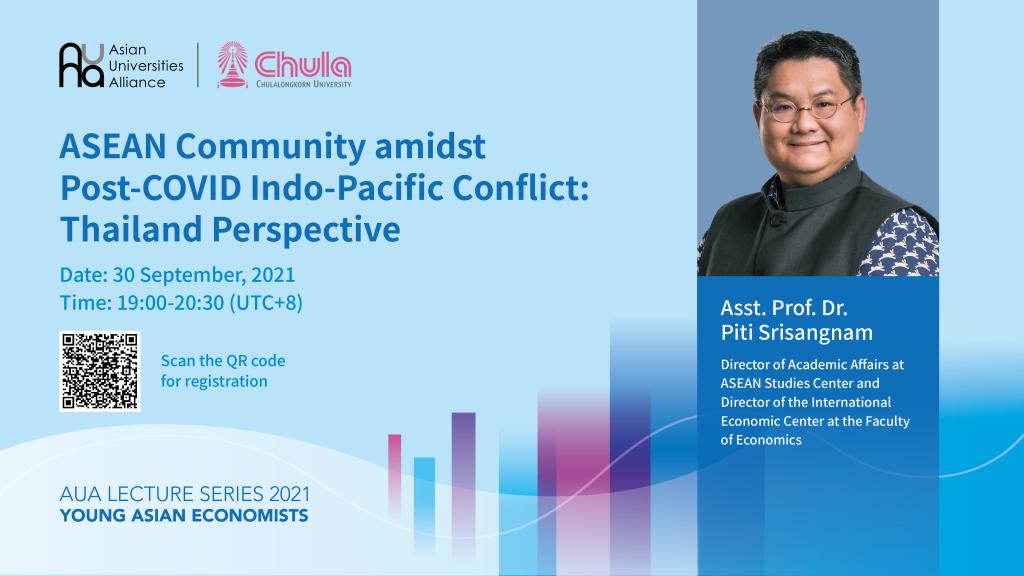
Theme: ASEAN Community amidst Post-COVID Indo-Pacific Conflict: Thailand Perspective
Professor: Asst. Prof. Dr. Piti Srisangnam, Director of Academic Affairs at ASEAN Studies Center and Director of the International Economic Center at the Faculty of Economics, Chulalongkorn University
Date: 30 September 2021 (Thursday)
Time: 19:00-20:30 (UTC+8)
Main points:
1. Conceptual Definition (Multiplex World)
2. Development of Global Value Chains and emerging opportunities
3. Critical Factors for the Changing World Order
Summary:
In the beginning, Professor Dr. Piti Srisangnam points out that the American World Order has gone. And several key factors underpin the demise of the US-led liberal hegemonic world order, including the rise of new powers and emerge of new threats such as terrorism. After that, Professor Dr. Piti Srisangnam illustrates the importance of ASEAN, China, and India from the perspectives of geographical locations, global logistics, energy resources & trade (such as crude oil).
The second part of the lecture focus on the GVCs (Global Value Chains). Developing countries in Asia benefit from the development of GVCs in many ways. Historical data indicates that huge economic losses took place when GVCs were disrupted. With the impact of COVID-19, the GVCs are expected to be recovered with new orders. In this sense, preparedness needs to be taken in facing emerging opportunities as well as challenges.
In the last part, Professor Dr. Piti Srisangnam illustrates the critical factors that will have influences on the World Order, namely, Disruptive Technology, GVCs, Logistics, and New Normal Unilateralism. In the expected new World Order, U.S. will still be the biggest economy, but it will no longer set the rules for the World. Instead, China will be the new superpower seeking economic opportunities, with a very friendly attitude. European Union will still be one of the leading characters for fashion, lifestyle, etc. And Japan will be the investor. In addition, there is an emerging rapidly growing region in the Bay of Bengal. In this case, ASEAN is facing a changing World Order in the next few years. 2021-2023 is a critical time for ASEAN.
In the discussion session, Professor Dr. Piti Srisangnam shares his thoughts about trends of international relationships, impacts on COVID-19, and the trust-building issue between China and other southeast countries.
(written by program student WEI Fang)
*The views and opinions expressed in this lecture series are those of the guest lecturers. They do not purport to reflect the opinions or views of the AUA or its members or its Secretariat.