The AUA–UoC Overseas Study Program 2026 — Water Pollution, Monitoring and Management: Emerging Challenges, Sustainable Strategies, and Smart Technologies was held online from 4 to 28 August 2026. Organized by the University of Colombo (UoC) under the Asian Universities Alliance (AUA) Student Mobility Module, the program brought together 61 students from 8 AUA member universities for an interdisciplinary exploration of the water resources protection and sustainable management.
Across 10 online guest lectures, academics, researchers, environmental specialists, technology practitioners, and legal and governance experts examined water pollution from multiple perspectives. Moving from the causes and consequences of pollution to monitoring and assessment, technological innovation, traditional water management, and governance, the program connected scientific knowledge with practical approaches for addressing complex water-related challenges.
From Global Water Risks to Sustainable Solutions
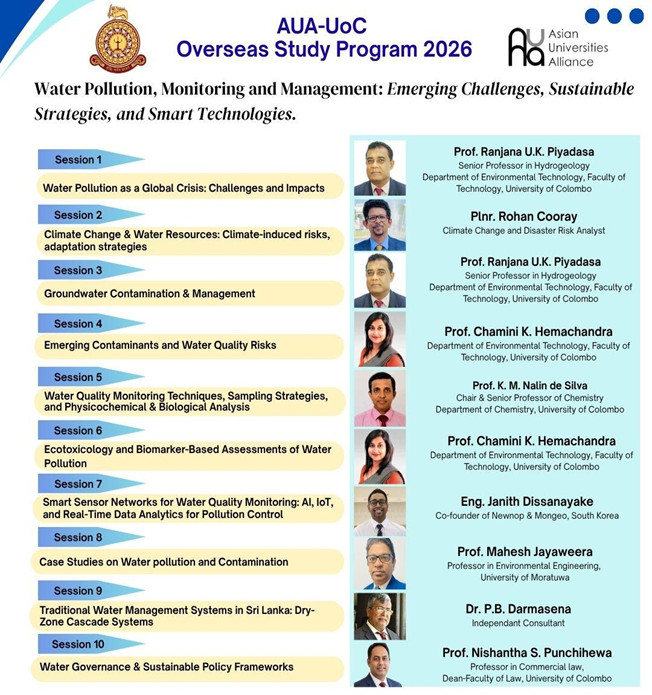
The program began on 4 August with Prof. Ranjana U. K. Piyadasa, Department of Environmental Technology, Faculty of Technology, UoC, who delivered “Water Pollution as a Global Crisis: Challenges and Impacts.” The opening lecture established the broader context for the program by examining water pollution as a global challenge and considering its implications for water security, ecosystems, and public health.
The focus then turned to the growing pressures of climate change. On 6 August, Plnr. Rohan Coorey, Climate Change and Financial Risk Analyst, delivered “Climate Change & Water Resources: Climate-induced Risks, Adaptation Strategies.” The session examined climate-induced risks to water resources and approaches to adaptation, highlighting the importance of sustainability and resilience in water management.
On 11 August, Prof. Piyadasa delivered “Groundwater Contamination & Management,” bringing greater attention to groundwater as a critical component of water security. The session examined contamination challenges and approaches to the protection of groundwater resources.
The fourth lecture, delivered on 13 August by Prof. Chamini K. Hemachandra from Department of Environmental Technology, Faculty of Technology, UoC, addressed “Emerging Contaminants and Water Quality Risks.” The session introduced participants to emerging threats to water quality and underscored the need for effective monitoring and management.
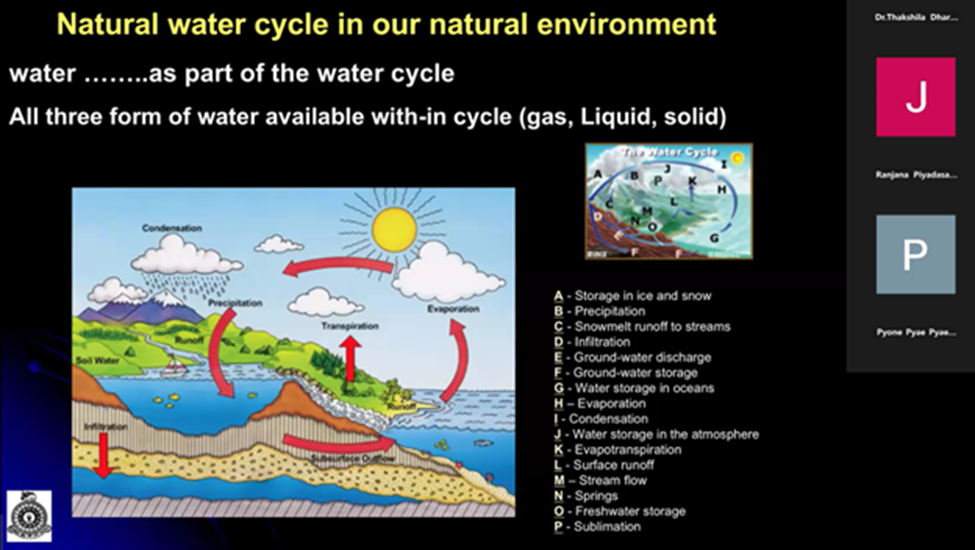
Together, these sessions established the foundation for understanding water pollution not as an isolated environmental issue, but as a challenge closely connected to water security, climate change, ecosystems, and human well-being.
From Monitoring Water Quality to Understanding Environmental Impacts
Having established the nature and scope of water-related risks, the program subsequently turned to the scientific approaches used to identify and assess them.
On 17 August, Prof. K. M. Nalin de Silva, Department of Chemistry, UoC, delivered “Water Quality Monitoring Techniques, Sampling Strategies, and Physicochemical & Biological Analysis.” The lecture introduced approaches to water quality monitoring, including sampling strategies and physicochemical and biological methods of analysis, providing a scientific foundation for understanding and evaluating changes in water quality.
The sixth lecture, “Ecotoxicology and Biomarker-Based Assessments of Water Pollution,” was then delivered on 19 August by Prof. Hemachandra. The session introduced ecotoxicological and biomarker-based approaches to assessing the effects of pollutants and examining environmental risks.
Taken together, the sessions demonstrated the importance of moving beyond identifying pollution toward developing reliable scientific approaches for monitoring, assessing, and understanding its environmental consequences.
Harnessing Smart Technologies for Water Quality Management
The program then explored how technological innovation can complement scientific approaches to environmental monitoring.
On 21 August, Eng. Janith Dissanayake, Chief Technology Officer and Co-founder of NEWNOP Co. Ltd. and Director of Business Development at Otherence Co., delivered “Smart Sensor Networks for Water Quality Monitoring: AI, IoT, and Real-Time Data Analytics for Pollution Control.” His session highlighted the potential of emerging digital technologies to support more connected, and data-informed approaches to environmental management.
By bringing technology into the topics, the program extended its focus from conventional monitoring and assessment toward emerging tools capable of supporting more responsive approaches to water-quality management.
Learning from Cases and Traditional Water Management Systems
The program also connected contemporary environmental challenges with practical experience and traditional knowledge.
On 24 August, Prof. Asoka Pathiratne, Faculty of Science, University of Kelaniya, delivered “Case Studies on Water Pollution and Contamination.” The session examined water pollution and contamination through case-based perspectives.
The ninth lecture, held on 26 August, was delivered by Dr. P. B. Dharmasena, Former Deputy Director of the Field Crops Research and Development Institute, Department of Agriculture, Sri Lanka. His lecture, “Traditional Water Management Systems in Sri Lanka: Dry-Zone Cascade Systems,” introduced participants to Sri Lanka’s traditional dry-zone cascade systems and their role in water management.
The inclusion of traditional water management broadened the program's perspective on sustainability, demonstrating how contemporary approaches to water management can be considered alongside established systems of local knowledge and resource management.
From Scientific Knowledge to Water Governance
The program concluded on 28 August with Prof. Sampath Punchihewa, Department of Commercial Law, Faculty of Law, UoC, who delivered “Water Governance & Sustainable Policy Frameworks.”
The final lecture brought a governance and policy dimension to the scientific, technological, and environmental perspectives explored throughout the program. It examined the importance of governance and policy frameworks in promoting sustainable water management and strengthening water security.
The concluding session reinforced a central theme running throughout the program: addressing water challenges requires not only scientific understanding and technological innovation, but also effective institutions, policies, and governance mechanisms capable of translating knowledge into sustainable action.
This AUA Overseas Study Program connected students from AUA member universities with experts from diverse academic and professional fields, enabling the sharing of knowledge on environmental challenges that extend beyond national borders. Across all the 10 sessions, the program brought together expertise from hydrogeology, climate change, environmental technology, chemistry, ecotoxicology, smart technologies, environmental science, agriculture, law, and governance. It reflected the increasingly interconnected nature of environmental challenges. By bringing together scientific inquiry, technological innovation, traditional knowledge, and governance perspectives, the program encouraged participants to view water not only as an environmental resource to be protected, but as a shared foundation for sustainable and resilient societies.
(Writer: Kim Tan | Editor: CAI Xiaodan)