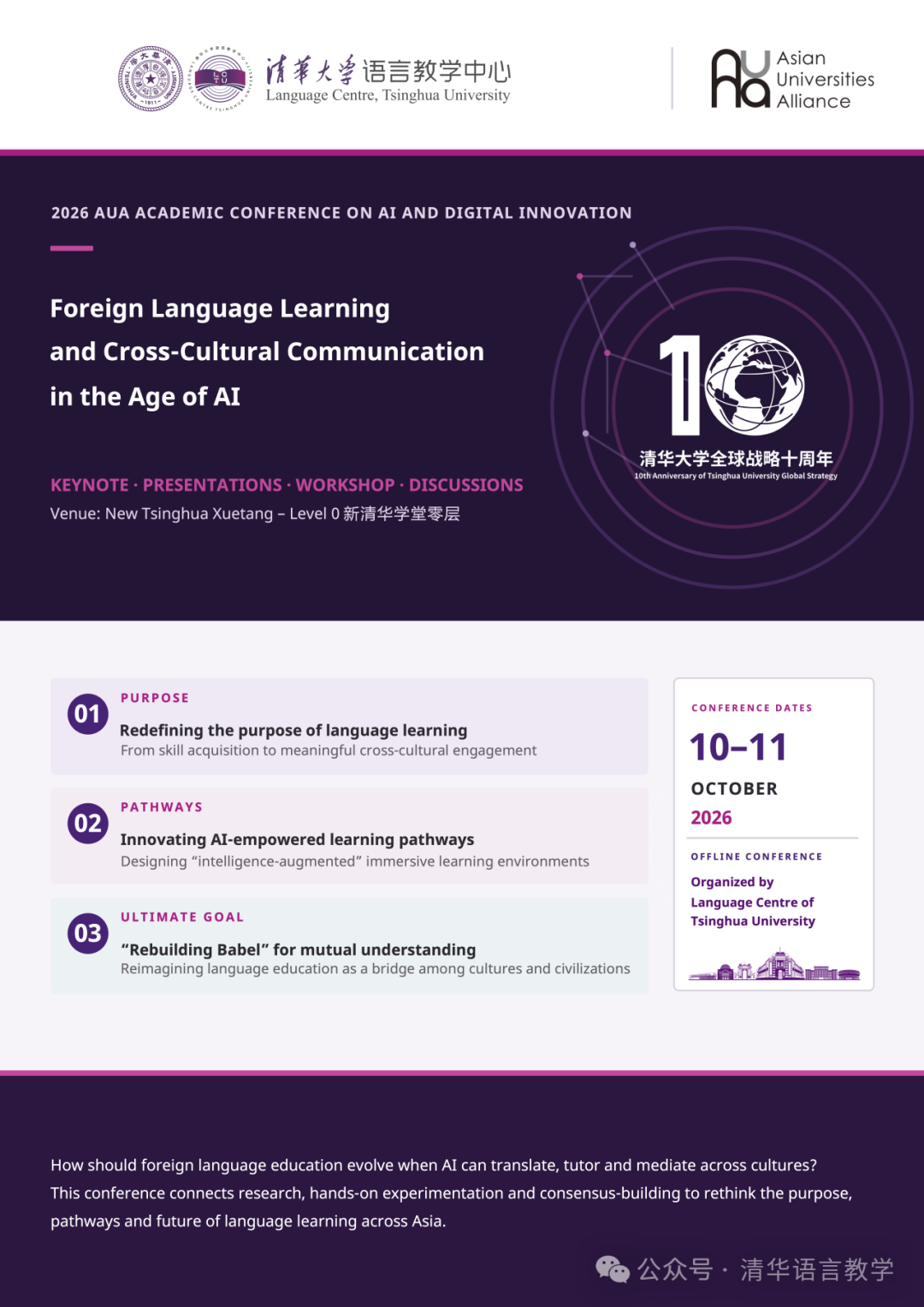
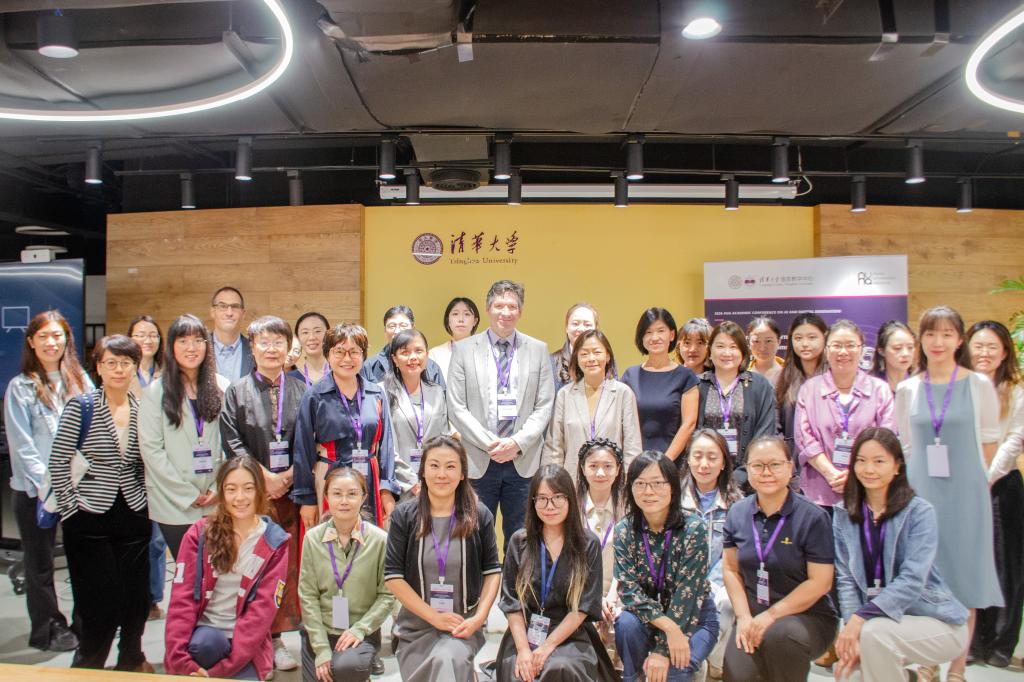
The 2026 Asian Universities Alliance (AUA) Academic Conference on AI and Digital Innovation, themed “Foreign Language Learning and Cross-Cultural Communication in the Age of AI”, took place at Tsinghua University on 10–11 October. Organised by the Language Centre of Tsinghua University, the conference brought together 48 faculty members, researchers and postgraduate students from 12 universities, including seven AUA member institutions.
The two-day programme featured a keynote speech, thematic presentations, a multilingual AI-empowered campus walk, a round-table discussion, a panel discussion and a working meeting. Drawing on academic research, teaching practice and first-hand communication experiences, participants engaged in in-depth discussions of the value of foreign language learning and cross-cultural communication in the age of AI, and new directions for language education.
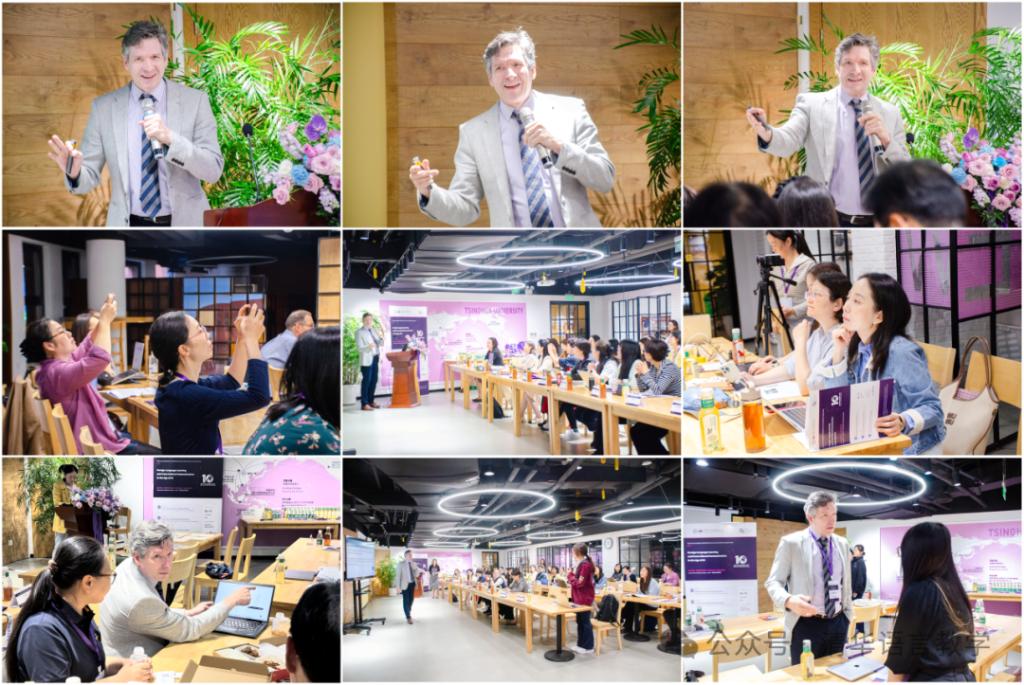
Keynote Address
Laurence Anthony, Professor of Applied Linguistics in the Faculty of Science and Engineering at Waseda University, Japan, delivered the keynote speech, “Rethinking Language Teaching in the Age of AI: From Needs to Evaluation”. Using examples from classroom practice, he illustrated how generative AI can be meaningfully integrated throughout language teaching, from needs analysis and goal setting to the design of materials and teaching methods, and the evaluation of learning outcomes.
ProfessorAnthony argued that language classrooms should continue to focus on language itself, rather than AI tools, and help students develop their own capacity to communicate across languages. At the same time, teachers need to consider the purposes, methods, responsibilities, and implications of integrating AI into teaching. He called for language learning goals that respond to the age of AI, with close attention to differences in what students can do with and without AI assistance. He concluded: “We are living through perhaps the most exciting transformation in the history of language education. By engaging critically with generative AI and verifying its outputs, we have a unique opportunity to rethink, and improve, language teaching and learning.”
Thematic Presentations
The thematic presentations addressed three areas: “Educational Governance and Learner Development in the AI Era”, “AI-Supported Language Teaching Design and Learning Assessment”, and “Cultural Learning and Intercultural Communication in the AI Era”. Fourteen presenters from universities including Tsinghua University, Peking University, the Hong Kong University of Science and Technology, the University of Malaya, Seoul National University and Sogang University shared their research and teaching approaches.
Round-table and Panel Discussions
The round-table discussion drew on the multilingual AI-empowered campus walk and participants’ experiences of communicating across languages to examine how AI changes communication and the value of foreign language learning in this process. Byeong Kwu Kang of Sogang University, Ping Pan of the Hong Kong University of Science and Technology, and Anh Thu Dam, an international student at Capital University of Physical Education and Sports, spoke on behalf of the three groups. They described how they had used AI to express ideas, obtain information, and learn about campus culture. They also highlighted the importance of people helping one another when tools failed, checking information, and drawing on the immediate context to understand meaning.
Invited speakers Yi Zhang and Russell Burgess, bothlecturers at Tsinghua’s Language Centre, extended the discussion through examples from English drama and academic English reading and writing classes, respectively. Their contributions explored the role of physical and emotional engagement and peer interaction in learning, as well as the knowledge needed to verify AI-generated output and the responsibility people bear for what they communicate.
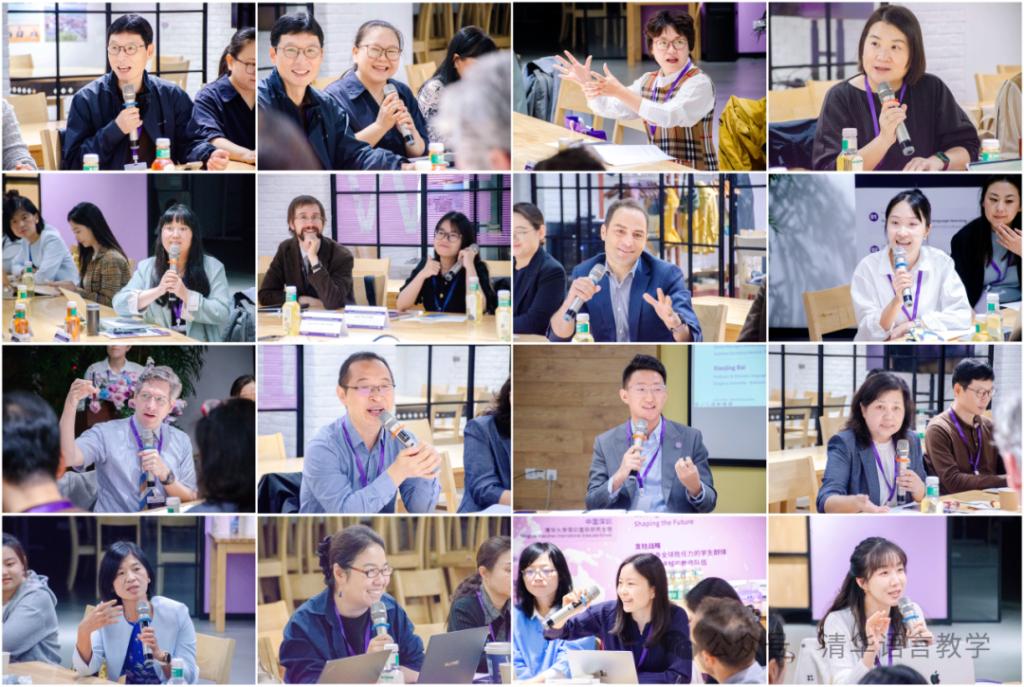
The panel discussion focused on the goals, learning processes, and assessment of foreign language education in the age of AI. The five panellists were Laurence Anthony of Waseda University, Shujing Li and Naiqiang Ma of Peking University, and Yifan Li and Xiaojing Bai of Tsinghua University. Drawing on their own practice, they shared reflections on the purposes of communication and human agency, the redesign of curricula and assessment, genuine understanding in cross-cultural communication, and the development of global competence and metacognition.
At the final working meeting, delegates reviewed the conference outcomes and discussed opportunities for future collaboration. They expressed a shared commitment to continuing teaching and research collaboration among AUA member universities, and looked forward to a future edition of the conference as an opportunity to deepen academic exchange and turn shared interests into collaborative practice.
(Source: Language Centre, Tsinghua University)